 Polygon
Polygon staking with POL delegation and rewards
Polygon staking lets POL holders delegate tokens to validators securing Polygon PoS and receive a share of staking rewards. For direct delegation, POL sits in Ethereum staking contracts, and the wallet pays transaction fees in ETH. The selected validator’s participation and commission affect the POL rewards credited to the delegation. Accrued rewards can remain claimable, return to the wallet, or become additional stake through restaking. Withdrawing the delegated principal involves unbonding before a separate claim becomes eligible. Liquid staking takes another approach: sPOL represents a share of pooled stake and accounts for rewards through its POL redemption rate.
- last updated
The short version: Restaked POL rewards become part of the delegation and inherit its checkpoint-based withdrawal delay.
Checkpoint rewards and validator earnings
Delegators earn POL through the staking reward allocation associated with their validator’s checkpoint participation, while validators also perform block production and checkpoint submission duties. A checkpoint records a commitment to Polygon PoS blocks on Ethereum. Reward accounting uses the eligible stake supporting participating validators, so a delegation’s share changes as the network’s stake changes. Missing checkpoint signatures can reduce the rewards attributable to a validator’s delegators. POL emissions fund network staking incentives, with reward parameters subject to governance changes.
Validator earnings and delegator rewards describe different allocations. Validators receive rewards for their own stake and commission from delegated stake. Their earnings can also include proposer rewards and transaction fee income governed by separate distribution rules. A validator’s total revenue therefore cannot be read directly as the amount available to delegators.
A displayed annualized rate projects earnings over a year. Its meaning depends on whether the calculation includes commission and reinvestment. POL rewards increase a token balance; changes in POL’s market value can still reduce that balance’s value in another currency.
What does direct delegation require on Ethereum?
Direct delegation requires POL available on Ethereum mainnet, a wallet able to authorize the staking contract calls, and ETH sufficient for the gas those calls consume. Native POL held on Polygon PoS belongs to a different network balance. Moving it through a bridge introduces the bridge’s own completion conditions and costs before it becomes usable on Ethereum. A bridge withdrawal still awaiting its Ethereum claim does not supply spendable POL for delegation. These prerequisites describe direct staking; a liquid-staking service can offer a different deposit route.
Reviewing a direct delegation before committing POL
With POL already available on Ethereum, a proposed delegation can be edited or abandoned before its transaction is signed. Review the chosen amount before authorizing spending or signing the delegation.
Some flows request a token approval before delegation; supported permit flows can combine authorization with the deposit. An approval grants spending permission without creating a stake.
- Confirm Ethereum mainnet holds the available POL balance, with separate ETH available for gas.
- Check the selected validator accepts delegation, then review its commission and checkpoint participation.
- Inspect any POL spending permission, including the staking contract receiving it and the authorized amount.
- Before signing the delegation, compare the deposit amount and gas estimate with the wallet’s balances.
- After execution, reconcile a successful Ethereum receipt with the recorded delegation amount for that wallet and validator.
A pending transaction, a successful approval, or a reverted delegation does not establish a new stake. Rejecting an unsigned delegation request leaves the proposed POL unstaked; an earlier confirmed approval remains a separate permission. After successful delegation, access to the principal follows the withdrawal conditions.
Validator commission and checkpoint participation
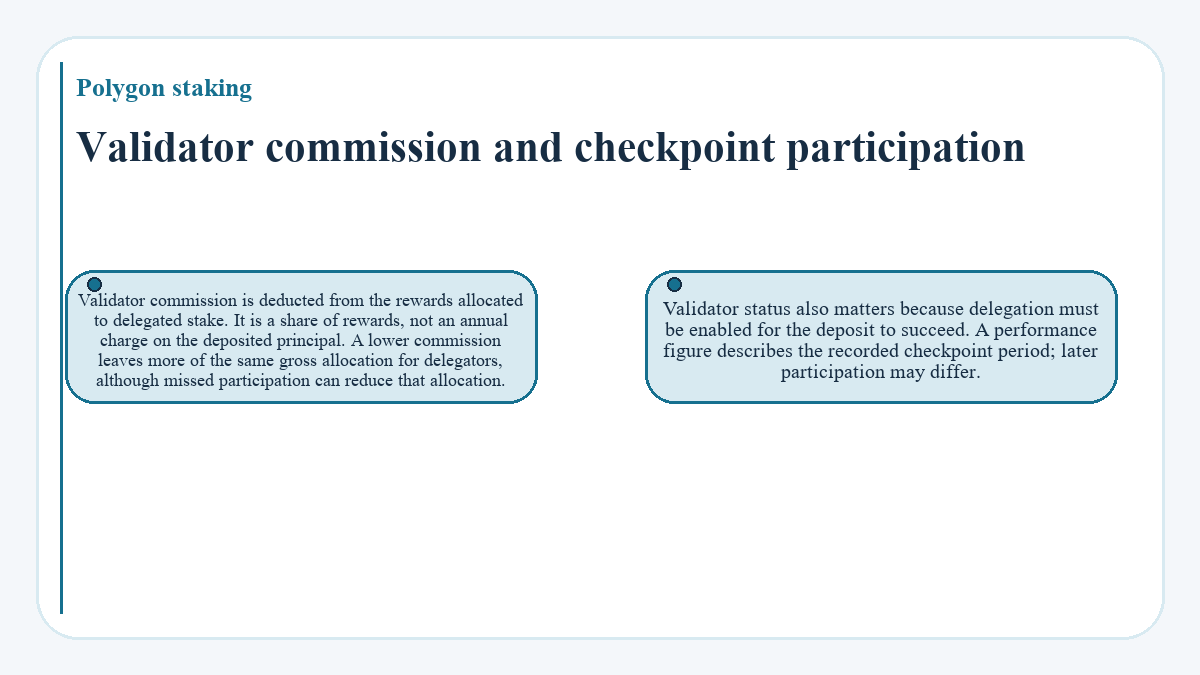
Validator commission is deducted from the rewards allocated to delegated stake. It is a share of rewards, not an annual charge on the deposited principal. A lower commission leaves more of the same gross allocation for delegators, although missed participation can reduce that allocation. Validator status also matters because delegation must be enabled for the deposit to succeed. A performance figure describes the recorded checkpoint period; later participation may differ.
How do claiming and restaking change the balance?
Claiming transfers accrued POL rewards into the wallet without withdrawing the delegated principal, while restaking converts available rewards into additional stake that participates in later reward allocations.
Direct delegation maintains separate accounting for stake and accrued rewards. Leaving rewards unclaimed does not automatically convert them into a larger direct delegation. The staking contracts calculate the wallet’s accrued share, and a supported reward operation determines its destination. Reinvested rewards inherit the validator’s participation and withdrawal conditions.
The contracts also support combined operations, including restaking while adding POL or starting an unbonding request. A particular interface may expose a narrower selection.
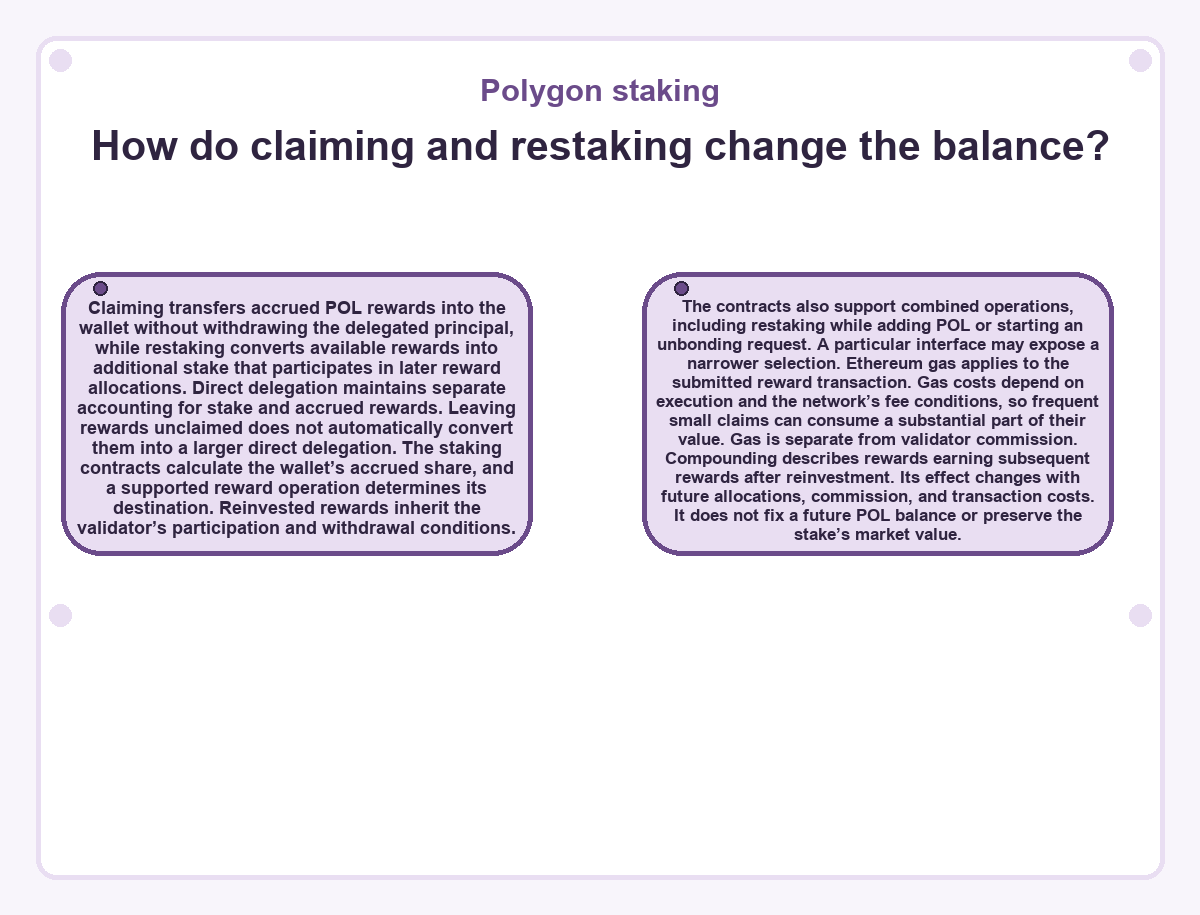
Ethereum gas applies to the submitted reward transaction. Gas costs depend on execution and the network’s fee conditions, so frequent small claims can consume a substantial part of their value. Gas is separate from validator commission.
Compounding describes rewards earning subsequent rewards after reinvestment. Its effect changes with future allocations, commission, and transaction costs. It does not fix a future POL balance or preserve the stake’s market value.
When can delegated POL be withdrawn?
The unbonded amount becomes claimable when the staking contract’s checkpoint-based withdrawal delay has elapsed. Unbonding removes that amount from active stake and stops its participation in subsequent staking rewards. The waiting period applies to principal and rewards already reinvested into the stake. Accrued rewards kept outside active stake follow their reward-claim rules. Any amount remaining actively delegated continues under the validator’s reward conditions.
Checkpoint progress determines withdrawal eligibility, so a clock estimate cannot establish that the stake is ready. Ethereum congestion or interrupted checkpoint submission can change elapsed time. The contract’s withdrawal-delay setting and the recorded unbonding state establish the applicable wait. Eligible principal still requires a claim transaction to return to the wallet. Unbonding confirmation and a completed withdrawal therefore represent different states. Once POL returns to the Ethereum wallet, it is available for other supported uses.
Liquid staking with sPOL
sPOL provides a transferable token representing pooled POL stake, with rewards reflected through its POL redemption rate rather than an increasing token count. Its underlying staking activity takes place on Ethereum. Deposits are supported from Ethereum and Polygon PoS, and the pool delegates across a managed validator set. This differs from personally maintaining a direct delegation to a chosen validator. Existing validator stake can also be migrated into sPOL through the supported migration flow without an unbonding wait or a gap in rewards. Reward compounding happens within the pool, and service fees affect the holder’s return. Validators in the sPOL program also agree to share a portion of priority transaction fees with delegators. The service also applies eligibility and jurisdiction restrictions to access.
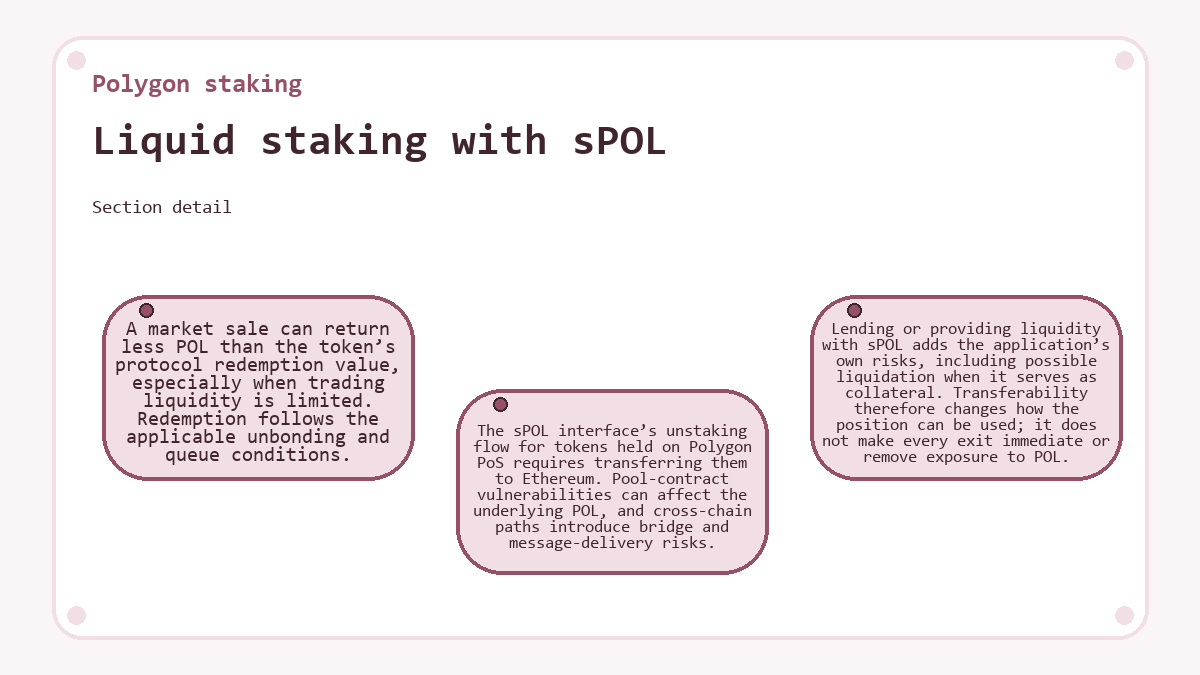
A market sale can return less POL than the token’s protocol redemption value, especially when trading liquidity is limited. Redemption follows the applicable unbonding and queue conditions. The sPOL interface’s unstaking flow for tokens held on Polygon PoS requires transferring them to Ethereum. Pool-contract vulnerabilities can affect the underlying POL, and cross-chain paths introduce bridge and message-delivery risks. Lending or providing liquidity with sPOL adds the application’s own risks, including possible liquidation when it serves as collateral. Transferability therefore changes how the position can be used; it does not make every exit immediate or remove exposure to POL.
Frequently asked questions
Does delegating POL require me to keep a validator node online?
A POL delegator does not need to operate a validator node or keep a wallet device online. Validators run the infrastructure responsible for network participation. The staking contracts retain the delegation after its transaction succeeds, and rewards follow the selected validator’s participation. Access to the wallet remains necessary to authorize later claims, restaking, or withdrawal transactions.
Can I move delegated POL to another validator without withdrawing it?
Direct delegation supports moving active stake to another eligible validator without first returning the principal to the wallet. The destination must accept the incoming delegation. The move updates the source and destination staking positions and uses an Ethereum transaction, so ETH gas applies. It is a different operation from unbonding for a principal withdrawal.
Will my existing MATIC delegation continue earning POL rewards?
Existing MATIC delegated to secure Polygon PoS was upgraded to POL during the September 4, 2024 migration without requiring a new delegation. The upgrade preserved staking participation and reward continuity. That automatic treatment applied to already staked MATIC; unstaked MATIC held on Ethereum has a separate migration process. The continuing position still depends on its validator’s participation and the network’s reward settings.
What happens to accrued rewards if I add more POL to the same validator?
The staking operation used to add POL determines whether accrued rewards return to the wallet or become additional stake. The buyVoucherPOL call pays them to the wallet, while restakeAndStakePOL reinvests them alongside the additional deposit. An interface may expose only some supported operations, so adding POL does not always have the same effect on accrued rewards.
Is a hardware wallet compatible with direct POL delegation?
A hardware wallet can authorize direct POL delegation through a compatible Ethereum wallet interface. The device must support signing the staking contract transactions through that connection. Its signing method does not change validator commission or the stake’s withdrawal conditions. Interface compatibility and any required device contract-signing settings determine whether the requested transaction can be authorized.
Are community airdrops part of the POL staking reward rate?
Community airdrops are separate from POL rewards credited by the staking contracts. Each distribution has its own eligibility and timing conditions, and liquid-staking participation can receive different treatment from direct delegation. A staking rate alone does not establish an entitlement to another token.